
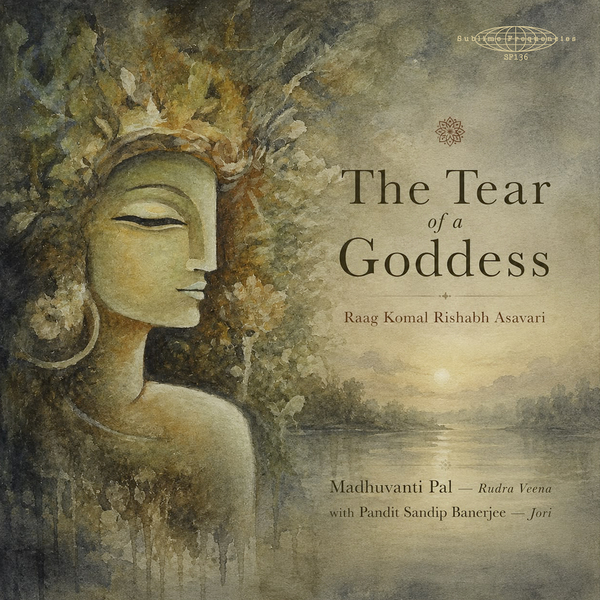
Madhuvanti Pal - Raag Komal Rishabh Asavari (The Tear of a Goddess) SF136-D
Sublime Frequencies is proud to present a very special digital only release: Raag Komal Rishabh Asavari (The Tear of a Goddess), a 95-minute raga played by Madhuvanti Pal on the Rudra Veena accompanied by Pandit Sandip Banerjee on the Jori. Madhuvanti has not only established herself as one of the world's most accomplished and progressive Rudra Veena players, but she also makes her own instruments and teaches students of the Rudra Veena from all over the world. As on her landmark first album, The Holy Mother (Sublime Frequencies 2023), she has recorded and mixed this raga herself, maintaining the intimacy of the listener being present in the room.
The Tear of a Goddess
Among the many legends that surround the ragas of India, few are as poignant as that of Asavari. It is said that just as Lord Shiva brought forth the Rudra Veena from his own being, he also created Asavari from his divine energy.
The story begins on Mount Kailash. Goddess Parvati, surrounded by sages, ascetics, attendants and Shiva’s spectral companions, longed for feminine companionship. She asked Shiva for a sister—someone with whom she could share the quiet intimacies of womanhood. Shiva granted her wish, but not in the way she had imagined.
From his own essence emerged Goddess Asavari.
She was the feminine reflection of Shiva himself: blue-skinned, clothed in leaves and animal hide, with unbound hair, cracked heels, and an insatiable hunger. She was neither delicate nor adorned, but wild, untamed, and fiercely elemental. At one feast upon Kailash, she consumed all the food prepared for the divine assembly, leaving none for the others. On another occasion, after a quarrel with Parvati, she imprisoned the goddess within the fissures of her own heel until Shiva intervened and restored her freedom. Following these events, Asavari was exiled from Kailash.
There, at the foot of the mountains, amidst dense forests and in the company of serpents—creatures with whom she shared Shiva’s sacred affinity—she made her dwelling. In the Ragamala paintings she is often portrayed in precisely this solitude: blue-skinned, surrounded by woodland, enchanting snakes with an effortless grace that is both fearsome and compassionate.
Perhaps this is why Raag Komal Rishabh Asavari has always felt to me like the voice of someone who belongs everywhere and nowhere at once. It carries within it a profound melancholy, yet never descends into despair. There is devotion in its sorrow and dignity in its loneliness. Though it employs the very same swaras as Raag Bhairavi, its personality could not be more different. Its phrases move in unexpected ways, unfolding with a character that is unmistakably its own.
My understanding of this raga was shaped many years ago by my revered guru, Vidushi Mita Nag. I first learnt it as a young violin student, long before the Rudra Veena became my life’s companion. The tenderness with which she revealed this raga, and the emotional depth of the composition she entrusted to me, have remained with me ever since. Even today, those melodies continue to echo through my memory.
The recording begins with an alap, jor, and jhala, offered with deep reverence to the Bishnupur tradition in which I was nurtured. The first composition, set in Chautal, draws its inspiration from the very composition I learnt from my guru all those years ago. It is followed by the traditional sooltaal composition Aan Sunāī Bānsurī Kanhā, cherished across Dhrupad Gharanas, conceived by the Dagar lineage. The recital concludes with one of my own compositions in the same raga—a humble offering in a tradition whose river has flowed for centuries before me, and, I hope, will continue long after my own voice has fallen silent.
A Note of Gratitude: Pandit Sandip Banerjee
There are accompanists who keep time, and there are accompanists who carry the soul of the music. Pandit Sandip Banerjee belongs unmistakably to the latter.
Long before I had the privilege of performing with him, he was already a cherished part of my musical world. As a young artist, my guru, Vidushi Mita Nag, practiced with his tabla accompaniment regularly, and over the years their association grew into a friendship built upon profound musical understanding and mutual respect. Having witnessed her artistic journey from close quarters, he came to understand the temperament, aesthetics, and inner pulse of the Bishnupur tradition in a way that very few musicians do.
Several years ago, after hearing me perform, he offered me an honest assessment. He felt that I was not yet ready—that my playing still bore the marks of inexperience. His words stung, but they were sincere. Rather than discouraging me, they quietly remained with me, urging me to become the musician I hoped one day to be.
When the time came to record these albums, I realized that I could not imagine them without him. Whether on the tabla or the jori, there is a rare gravity in his playing that I have seldom encountered elsewhere. He does not merely accompany; he listens, breathes, and allows the music to unfold with remarkable patience and dignity.
Even then, I hesitated. I lacked the courage to ask him myself and requested Mita Didi to speak to him on my behalf. He graciously agreed, but with one condition: he would first rehearse with me, and only if he felt I was ready would he agree to record.
That rehearsal remains one of the most meaningful moments of my musical life.
To my immense relief, he was pleased. More importantly, what followed felt astonishingly natural. There was no struggle to understand one another, no effort to find common ground. He seemed to instinctively recognize every breath, every hesitation, every emotional turn of the music. His rhythmic responses never overshadowed the Rudra Veena; instead, they embraced it with quiet strength and unwavering devotion. The comfort I experienced while performing beside him is something words can scarcely convey.
What was initially meant to be a single recording gradually became many. Somewhere along the way, I realized that I no longer wished to imagine these musical journeys without him. As long as fate permits, I hope to continue recording with Pandit Sandip Banerjee.
When his jori meets the voice of the Rudra Veena, I hear something that feels older than either of us. I hear the echo of the ancient rhythmic traditions of Bishnupur, as though the terracotta temples themselves had found a heartbeat. In those moments, it feels less like accompaniment and more like a homecoming.
- Madhuvanti Pal, July 2026
Raag Komal Rishabh Asavari
1. Alap Jod Jhala 44:42
2. Chautaal Composition 25:18
3. Compositions in Sooltaal 24:28
Madhuvanti Pal - Rudra Veena
with Pandit Sandip Banerjee - Jori
Cover artwork by Madhuvanti Pal